
Lab Facilities - Mechanical Engineering
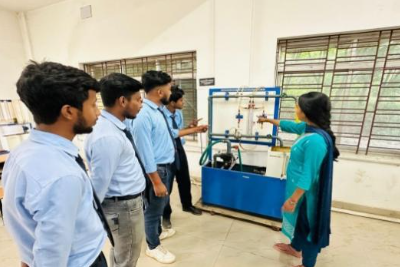
Fluid Mechanics Lab
In this lab, students study fluid properties and flow behavior through a variety of experimental setups. The lab includes flow measurement devices such as venturimeters, orifice meters, notches, and pipes. It helps students understand fundamental concepts like laminar and turbulent flow, fluid friction, and continuity and momentum equations. The experiments enhance skills in applying theoretical principles to fluid system designs.
View More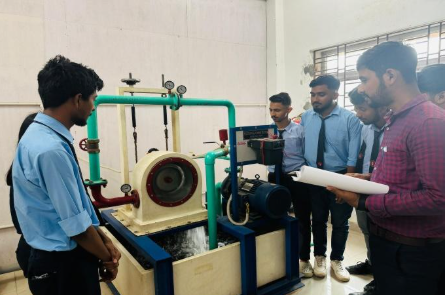
Fluid Machines Lab
The lab offers practical training in the working and analysis of hydraulic turbines and pumps. Students study the performance characteristics of Pelton, Francis, and Kaplan turbines as well as centrifugal and reciprocating pumps. Through experiments, they learn to measure discharge, efficiency, head loss, and energy transfer. The lab plays a key role in understanding fluid power applications in industries and water resource systems.
View More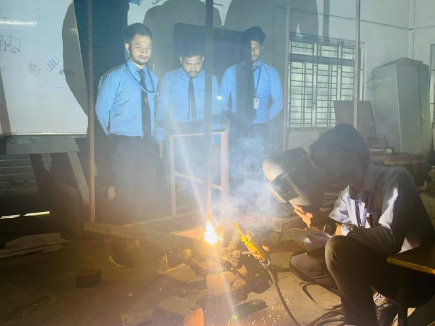
Manufacturing Process Lab (Central Workshop)
This workshop trains students in conventional manufacturing processes including turning, milling, drilling, fitting, arc welding, and gas welding. Students learn to operate lathes, shaping machines, and grinders, gaining proficiency in basic fabrication skills. The lab emphasizes safety, accuracy, and craftsmanship—critical in production and mechanical maintenance.
View More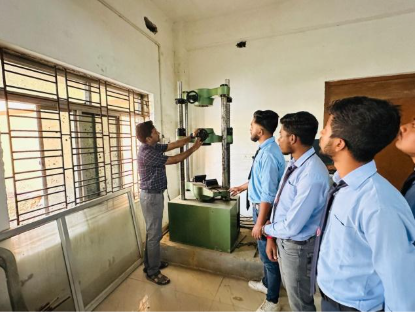
SOM Lab
This lab provides hands-on experience in testing the mechanical properties of materials such as mild steel, aluminum, and brass. Equipped with Universal Testing Machines (UTM), impact testing machines, and hardness testers, students analyze stress-strain behavior, elasticity, ductility, and toughness. These insights are essential for selecting suitable materials in construction, machine design, and structural engineering.
View More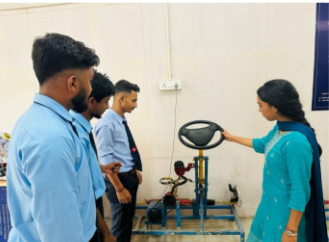
Automobile Engineering Lab
Students explore various subsystems of automobiles, including engines, transmissions, brakes, steering, and suspension. Using actual vehicle components and working models, they gain insights into engine testing, fuel supply systems, and emission control. The lab provides a solid foundation for careers in automotive design and service engineering.
View More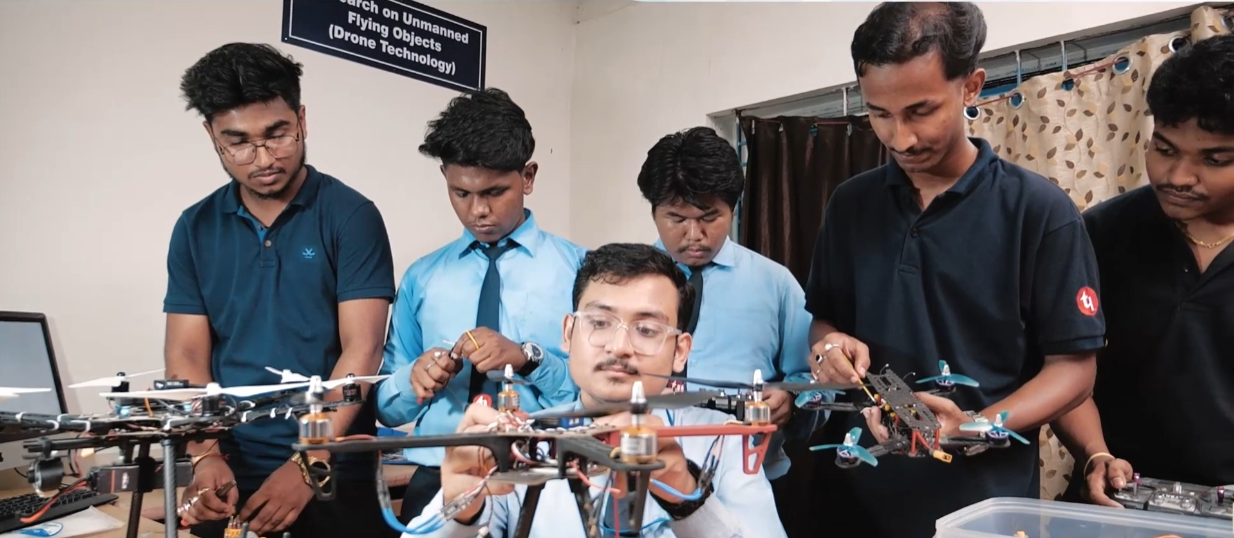
Advanced Manufacturing and Robotics Lab
Equipped with industrial robots, 3D printers, and automation kits, this lab focuses on Industry 4.0 technologies. Students learn robot kinematics, additive manufacturing, and mechatronic integration. It encourages research and innovation in smart manufacturing, flexible automation, and robotics for industrial and research applications.
View More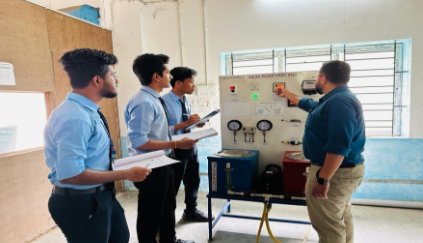
Heat Transfer Lab
Students explore the three modes of heat transfer—conduction, convection, and radiation—using experimental setups such as pin fin apparatus, composite wall apparatus, and heat exchangers. They analyze thermal gradients, insulation properties, and heat transfer coefficients. This lab is essential for applications in thermal design, HVAC systems, and energy conservation technologies.
View More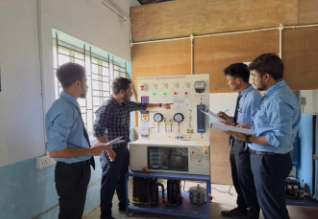
Refrigeration & Air Conditioning Lab
This lab provides exposure to the principles and components of cooling systems. Students conduct performance tests on vapor compression and absorption refrigeration systems, air conditioners, and cooling towers. Using psychrometric charts, they study humidity, enthalpy, and air-conditioning loads. It prepares students for careers in refrigeration, HVAC design, and thermal management industries
View More