
Lab Facilities - Electrical Engineering

Analog Electronics Laboratory
The Analog Electronics Laboratory is designed to provide students with practical knowledge and hands-on experience in fundamental analog electronic circuits and devices. The course covers identification and testing of passive and active components, use of electronic instruments (CRO, DMM, Function Generator), and experimental analysis of diode and transistor characteristics. Students will explore rectifiers, transistor biasing, amplifier configurations, FET operations, and oscillator circuits. This lab builds foundational skills essential for understanding, designing, and analyzing analog systems in real-world applications.
View More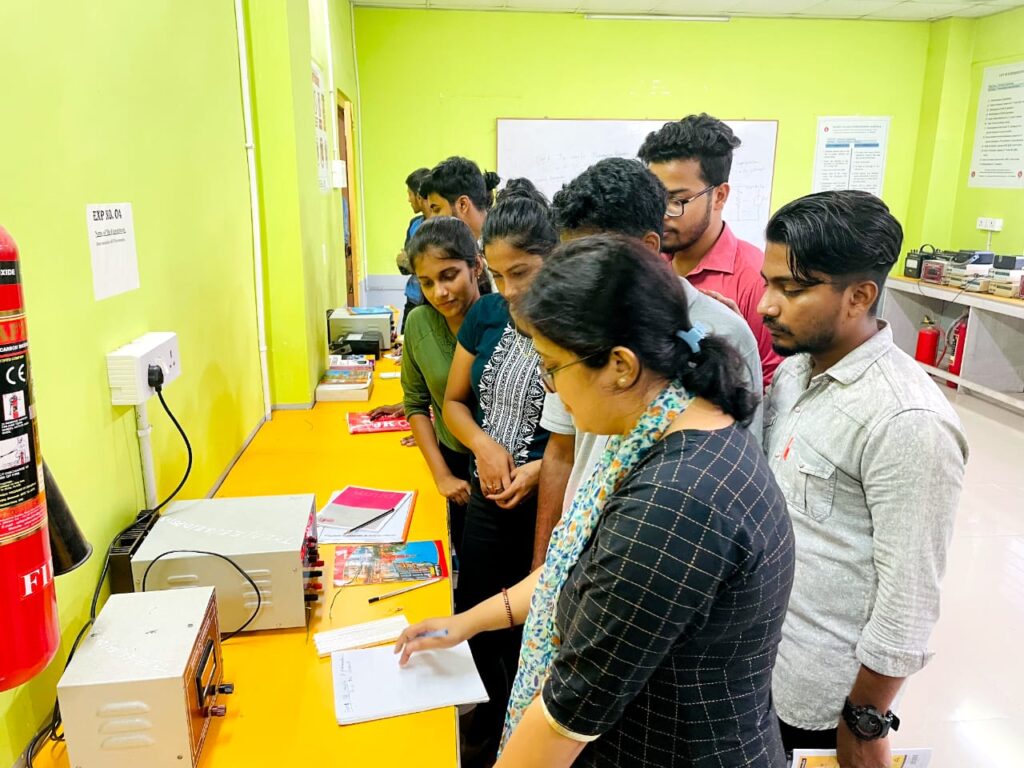
Electrical Circuits Laboratory
The Electrical Circuits Laboratory is designed to provide students with practical exposure to fundamental and advanced concepts in electric circuit theory. The lab supports the theoretical knowledge gained in classroom lectures by offering hands-on experience with real-world circuits and measurements.This course introduces students to a wide range of electrical circuit experiments that reinforce the understanding of network theorems, transient and steady-state responses, frequency response analysis, resonance, and two-port network parameters. Through systematic experimentation, students gain insights into the behavior of R, L, and C components under different excitation conditions, including DC and AC inputs, transient states, and continuous periodic signals.
View More
Electrical Estimation Design Practice Laboratory
This course provides a comprehensive understanding of electrical system components and their applications in residential, commercial, and industrial installations. Students will learn about LT wiring systems, protective devices, and electrical safety practices. The course covers the design and planning of residential and commercial electrical systems, including load calculation, component selection, and earthing. It also introduces illumination systems, focusing on lighting design, modern lighting technologies, and energy-efficient practices. Additionally, the course explores industrial systems such as DG sets, UPS systems, and battery banks, emphasizing their sizing and selection.
View More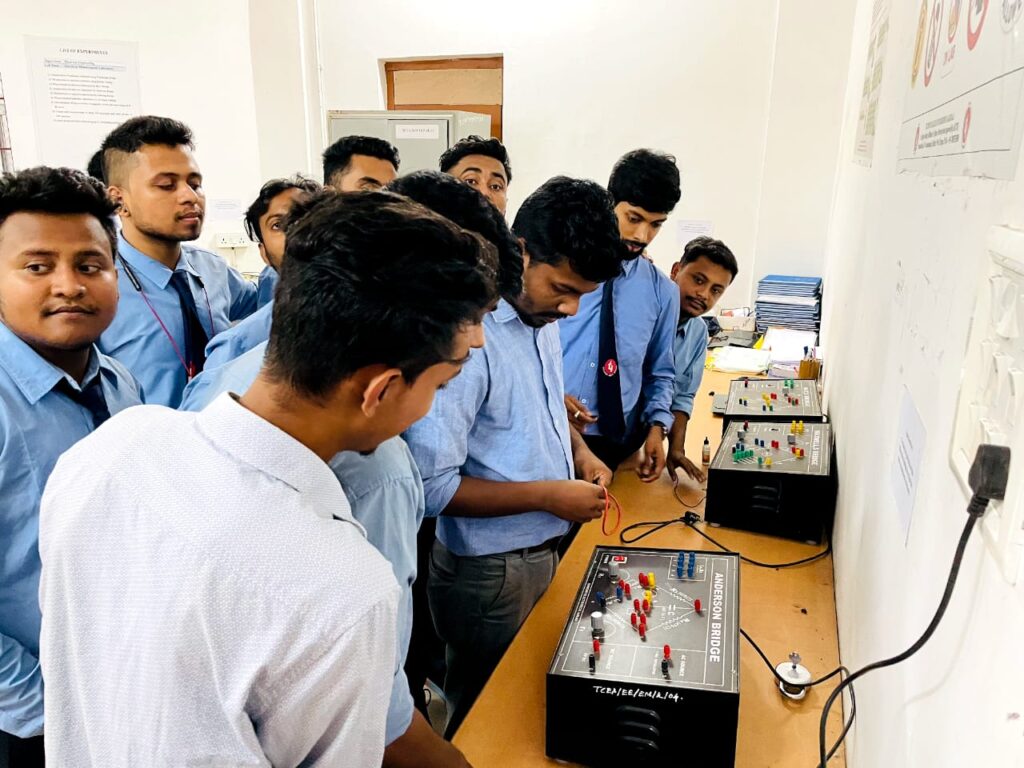
Basic Electrical Measurements Laboratory
The Basic Electrical Measurement Laboratory is designed to provide students with practical experience in measuring electrical quantities and understanding sensor behavior used in industrial and laboratory applications. The course covers a wide range of measurement techniques, including bridge methods for determining inductance, capacitance, and resistance, as well as power measurement in three-phase systems using the two-wattmeter method.Students gain hands-on experience with instruments such as DC ammeters, voltmeters, meggers, and sensor systems like thermistors, RTDs, thermocouples, strain gauges, and LVDTs. The lab emphasizes accurate measurement, calibration, sensitivity analysis, and the limitations of different instruments.By the end of the course, students will have a strong foundation in electrical and sensor measurement techniques, enabling them to apply these skills in instrumentation, automation, and electrical engineering projects.
View More
Power Electronics Laboratory
The Power Electronics Laboratory is designed to provide practical exposure to the operation,characteristics, and applications of power semiconductor devices and converter circuits. Through a series of hands-on experiments, students gain a thorough understanding of the switching behavior of devices like SCR, TRIAC, MOSFET, and IGBT, along with their triggering methods.The lab emphasizes the design and analysis of various firing circuits (R, RC, and UJT-based) and their implementation in power control applications. Students study the performance of half- and fully-controlled converters for both single-phase and three-phase AC-DC conversion using SCRs. Additionally, experiments include the operation of choppers and thyristorized speed control of DC motors, which are critical in industrial drive systems. This laboratory enhances students’ ability to build, test, and analyze power electronic circuits, preparing them for advanced applications in power conversion and motor control systems.
View More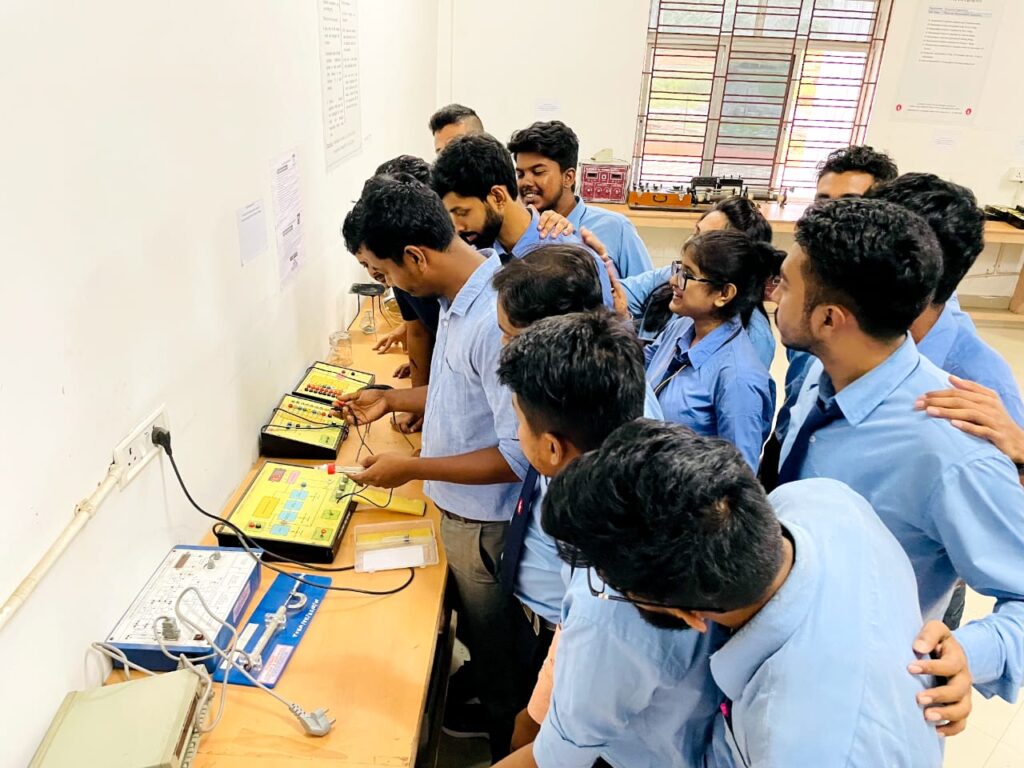
Control System Laboratory
Control Systems Laboratory provides practical experience in modeling, analysis, and control of DC servomechanisms and electro-mechanical systems. Students perform experiments to derive transfer functions, analyze steady-state errors, and implement various controllers (P, PI, PD, PID) for position and speed control. The lab also explores velocity feedback effects, pole placement using state feedback, and disturbance handling in multi-disc systems. Through hands-on work, students gain a deeper understanding of second-order system behavior, feedback control, and modern control strategies.
View More
Power System Laboratory
The Power System Laboratory offers hands-on experience in analyzing and testing key components of electrical power systems. Students conduct experiments on transmission line performance, including no-load tests, Ferranti effect, ABCD parameter determination, and load regulation. Fault analysis for both symmetrical and unsymmetrical conditions is performed and compared with theoretical results. The course also includes practical studies of DC distribution networks and protection systems, such as Buchholz relays, differential relays, and numerical motor protection relays. Students also learn to test and plot characteristics of over-voltage and under-voltage relays, enhancing their understanding of real-world power system operation and protection.
View More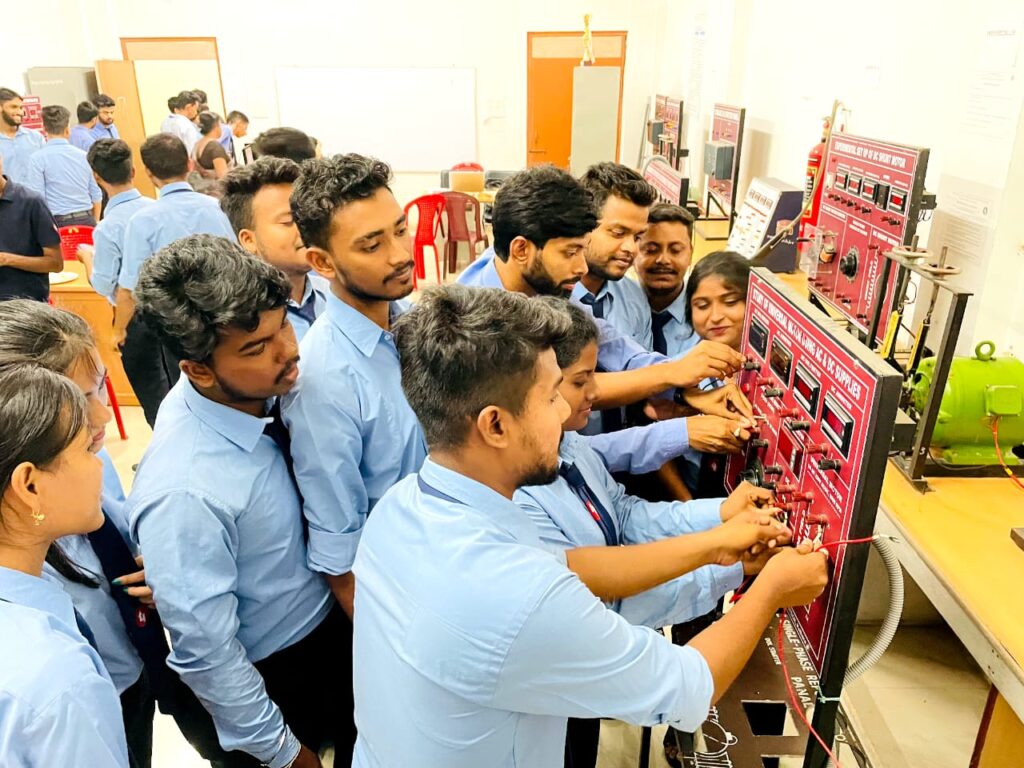
Electrical Machine Laboratory
The Electrical Machines Lab is designed to provide hands-on experience in understanding the fundamental operating principles and performance characteristics of DC machines and single-phase transformers. Through a series of structured experiments, students gain practical knowledge of testing methods, control techniques, and performance evaluation of electrical machines.
View More